
Hyperbaric oxygen therapy: pressure, oxygen and the chamber
What happens inside a hyperbaric chamber, described as physics and as operation: pressure, oxygen, the session, the people who run it and what a center plans for. Hipertech manufactures the chambers; how they are used clinically is decided by physicians.
Oxygen at a pressure above sea level
Hyperbaric oxygen therapy (HBOT) means breathing 100% oxygen at a pressure higher than the atmosphere at sea level, inside a pressure chamber.
The chamber is a pressure vessel for human occupancy (PVHO): it holds the pressure, and the occupants breathe the oxygen through a mask or a hood. The session pressure, the breathing gas and the length of each session are set by the physician responsible for the chamber.
Henry’s law and Boyle’s law
Two laws of gas physics describe what pressure does inside a chamber. They are stated here as physics only.
More pressure, more dissolved gas
The amount of a gas that dissolves in a liquid rises with that gas’s pressure. Breathing 100% oxygen above 1 ATA therefore dissolves more oxygen in the blood plasma than breathing air at sea level, and the amount keeps rising with the pressure.
Calculated with the alveolar gas equation and Henry’s law, the method stated in the HBOT Guide. Dissolved oxygen only: the chart does not show the oxygen carried by haemoglobin.
More pressure, less volume
At a constant temperature, the volume of a fixed amount of gas falls as its pressure rises: double the absolute pressure and the volume halves. A gas space that fills 100% of its volume at sea level fills 50% at 2 ATA, about 36% at 2.8 ATA and about 33% at 3 ATA.
Boyle’s law for an ideal gas at constant temperature.
Pressure and depth
Chamber pressure is stated in atmospheres absolute (ATA). 1 ATA is the pressure of the atmosphere at sea level, and each 10 m of seawater adds about 1 ATA, so a chamber at 2 ATA holds the pressure found about 10 m down and a chamber at 2.8 ATA the pressure about 18 m down.
| Pressure, ATA | Seawater depth equivalent |
|---|---|
| 1.0 | Sea level, 0 m |
| 2.0 | About 10 m |
| 2.8 | About 18 m |
| 3.0 | About 20 m |
Points on the scale, not session pressures or a chamber rating.
How a session is run in a hyperbaric chamber
A session is a pressure cycle the operator runs from outside the chamber: compression, a period at session pressure while the occupants breathe oxygen, then decompression. The pressure, the breathing gas and the length of each session are set by the physician responsible for the chamber.
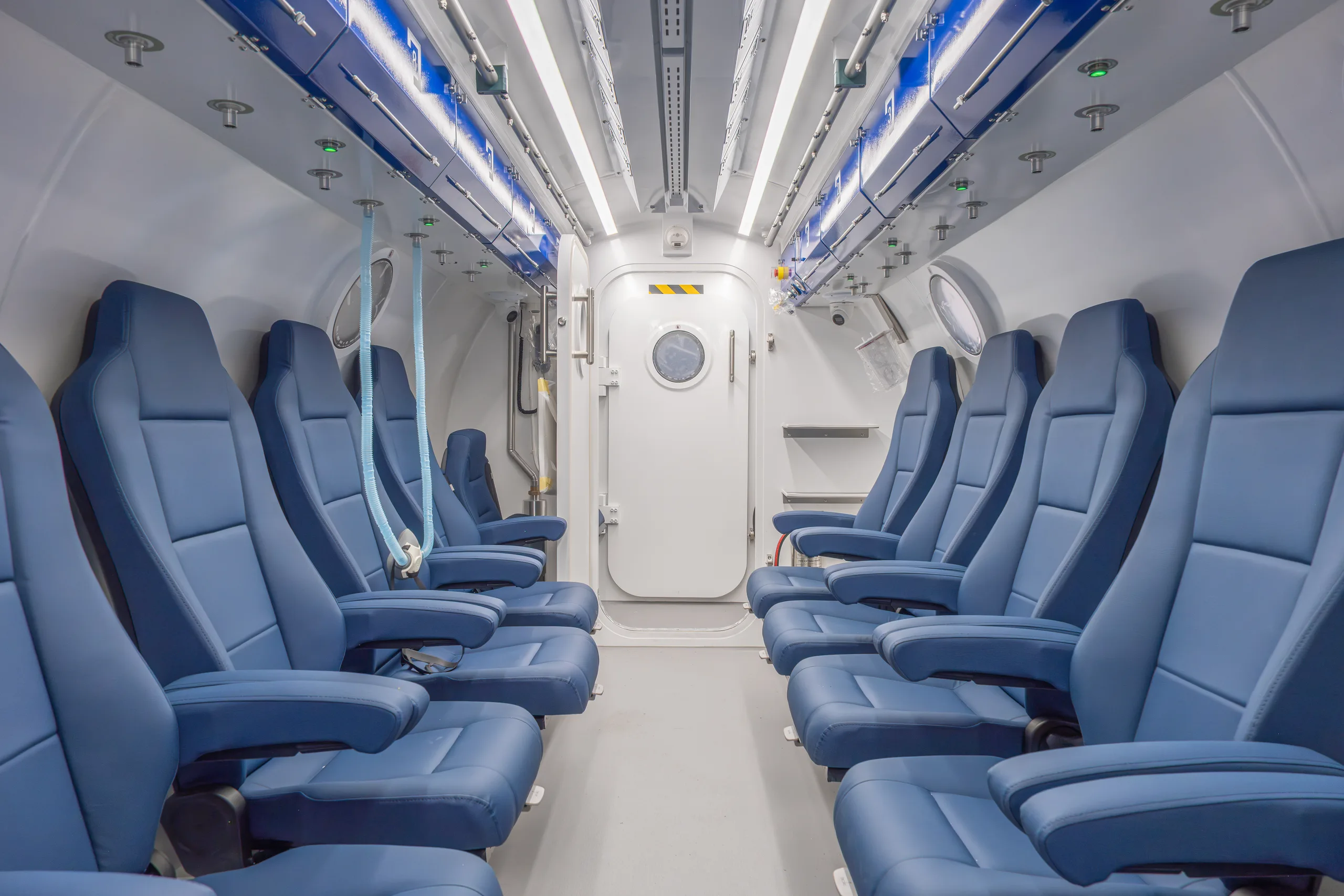
The occupants go in at sea-level pressure. In a multiplace chamber the patients take their seats with a medical attendant inside; in a monoplace the single patient lies on a height-adjustable stretcher that runs into the hull, and the door is closed and locked.
The operator raises the pressure gradually, so the occupants can equalize their ears as it rises. Pressure is stated in atmospheres absolute (ATA): 1 ATA is sea-level pressure, and each 10 m of seawater adds about 1 ATA, so 2 ATA is the pressure about 10 m down and 2.8 ATA the pressure about 18 m down.
At session pressure the occupants breathe 100% oxygen. Each patient breathes it through a mask or a hood while the chamber itself holds compressed air, in a monoplace as in a multiplace. Under pressure more oxygen dissolves in the blood plasma than at sea level, because the amount of a gas that dissolves in a liquid rises with its pressure (Henry’s law).
Where the physician’s protocol includes them, the occupants come off oxygen at set intervals and breathe air for a short period before going back on oxygen. The pressure does not change during an air break.
At the end of the session the operator brings the chamber back down to 1 ATA at a controlled rate, and the occupants leave once it is at sea-level pressure.
Monoplace or multiplace
Hipertech builds both kinds of medical chamber. Which one a center needs follows from how many people it seats at once, whether staff work inside it, and the room it has.
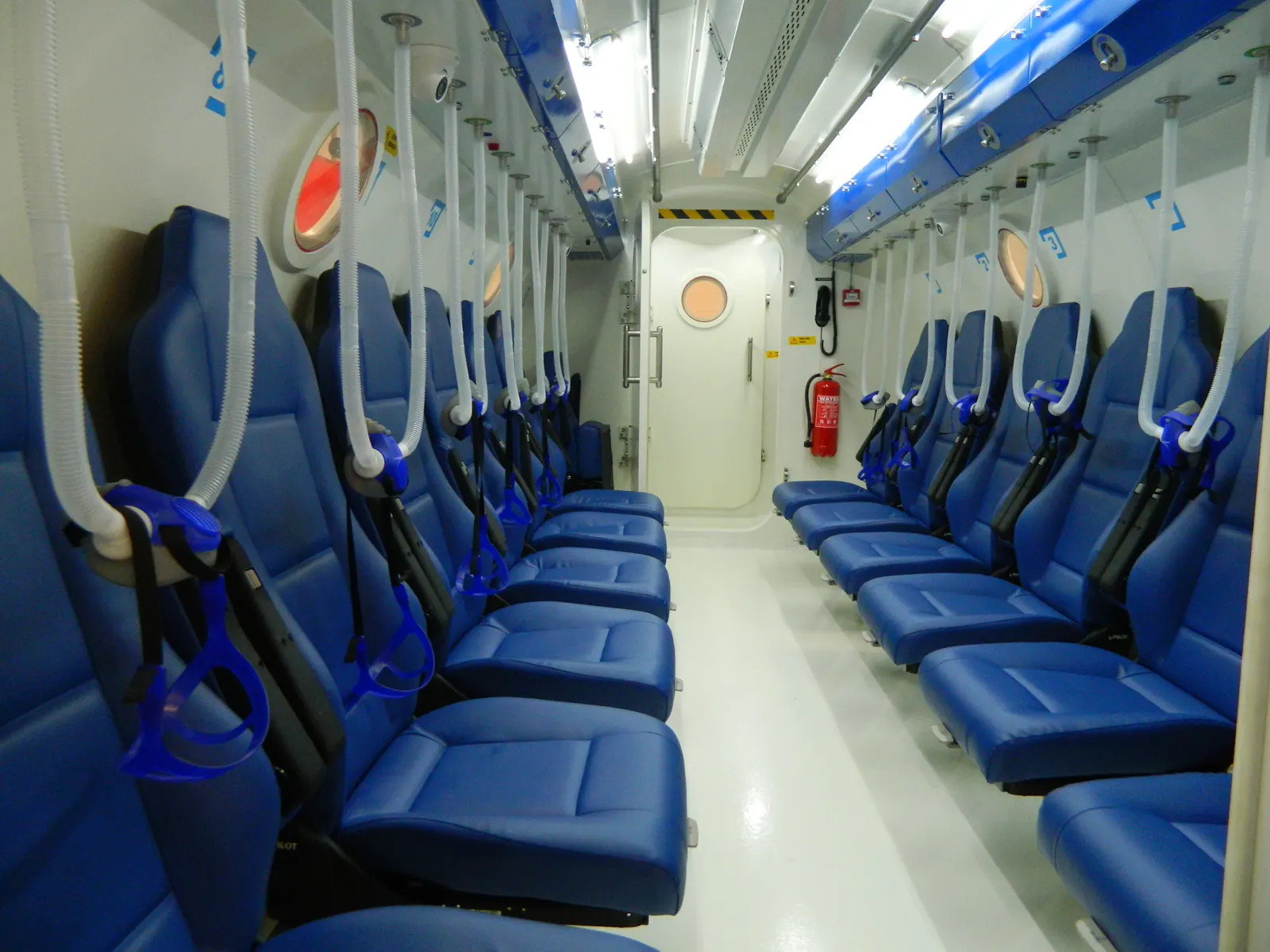
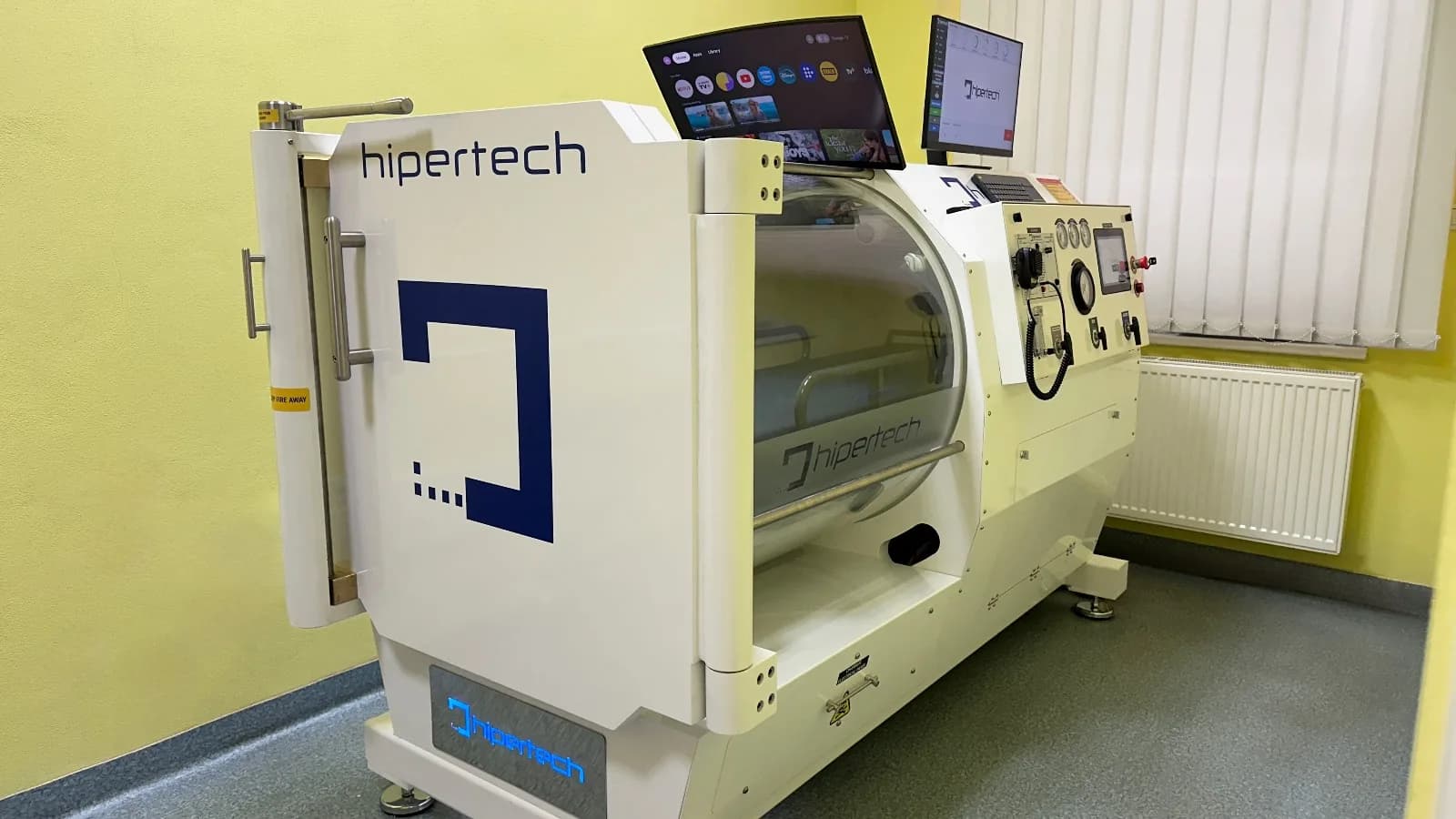
| Multiplace: Omega and Quadro | Monoplace | |
|---|---|---|
| Occupants | Seated patients with medical attendants inside, written as patients + attendants: Omega standard configurations run from 4+2 to 14+2 | One patient, lying on a height-adjustable stretcher |
| Chamber atmosphere | Compressed air | Compressed air |
| Oxygen | Through a mask or a hood at each seat | Through a mask |
| Inside with the patients | A medical attendant | No one; the chamber is worked from outside |
| Hull | Omega: omega-shaped section, a cylinder cut flat at the floor. Quadro: rectangular section | Full-clear or semi-clear acrylic or Lexan hull, to ASME PVHO |
| Access | Quadro: a 120 cm door with lightweight ramps for ICU stretchers, and a low threshold for wheelchairs | An internal stretcher that runs fully out of the open end |
| Control | HiperFlow: a 6-screen control desk on the Omega, a customised automation option on the Quadro | HiperFlow automation system, with an operator panel at the chamber |
| Room | A chamber room with the plant behind it | A room the hospital already has, with power, a gas supply and an access route the hull will pass through |
The people who run a session
Roles
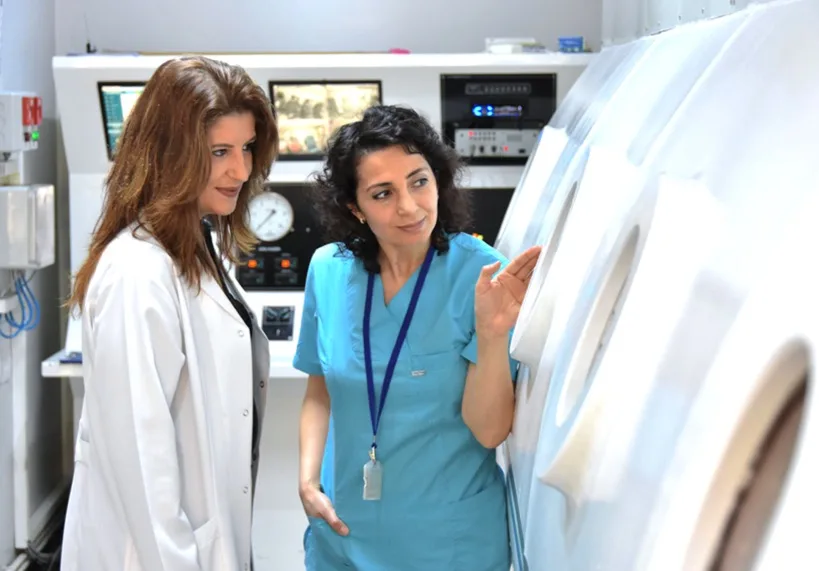
- Physician
- The physician responsible for the hyperbaric service selects the patients and sets each session’s protocol: the pressure, the breathing gas and the length of the session.
- Chamber operator
- Runs the chamber from outside it, at the HiperFlow control desk or the monoplace’s operator panel, through compression, the time at pressure and decompression.
- Inside attendant
- In a multiplace chamber a medical attendant sits inside with the patients; the second figure in a configuration such as 12+2 counts the attendants.
- Technicians
- Keep the chamber’s air and oxygen supply, fire suppression and control system in service.
- Hipertech Academy
- Medical, technical, maintenance and safety training for these roles, with certification by Hipertech on completion. Training runs online or on site: at the customer’s chamber after installation, or at HBO Group’s centers in İstanbul, where trainees observe live sessions.
Safety systems and the standards behind them
Every Hipertech medical chamber is designed and manufactured to EN 14931, ASME PVHO, NFPA 99, the Pressure Equipment Directive 2014/68/EU and the Medical Device Regulation (EU) 2017/745, under an EN ISO 13485:2016 quality system, and carries the CE mark. The safety systems differ by family and are listed for each family separately.
Safety systems, per family
- Multiplace Omega
- Constant oxygen concentration monitoring, AI patient surveillance at every seat, three-stage fire suppression to EN 16081 and NFPA 99.
- Multiplace Quadro
- Three-stage fire suppression to EN 16081 and NFPA 99, under the HiperFlow automation system.
- Monoplace
- An O₂ analyser with over-limit alarm, a fire fighting system to NFPA 99, a patient alarm and quick-stop button, a safety door lock, an emergency depressurisation valve, and a data-logger that keeps session records for up to two years.
Planning a center: room, gas supply, staff and readiness
The physician decides who is seen and at what pressure; the chamber, the room and the team have to be ready for what that physician prescribes.
What a center plans for
- Room and plant
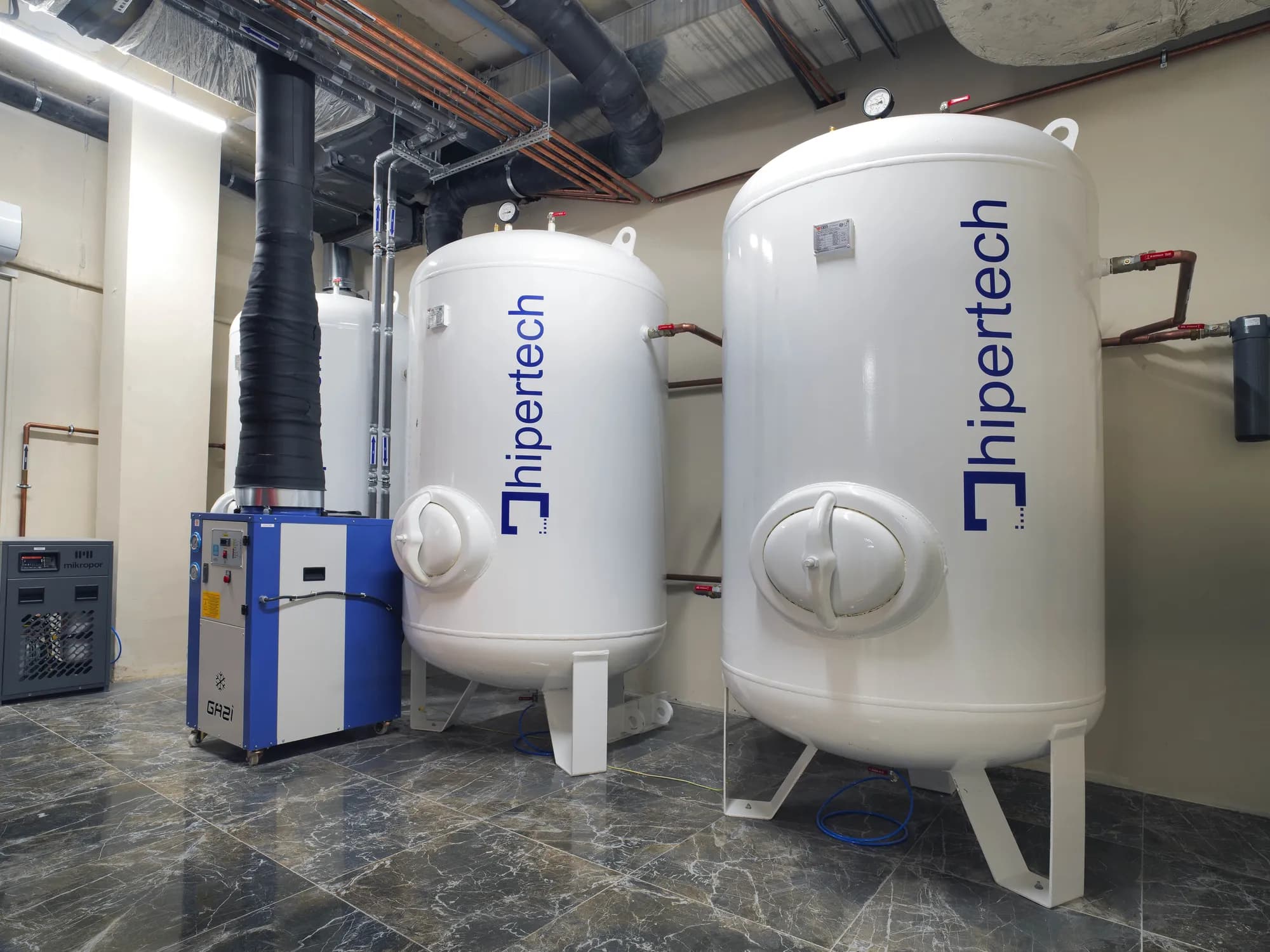
- Power, a gas supply and an access route the hull will pass through; for a multiplace chamber, a plant room as well.
- Gas supply
- Oxygen for the masks or hoods, and compressed air for the chamber atmosphere, in a monoplace as in a multiplace.
- Staff
- A responsible physician, a chamber operator, an attendant for multiplace sessions and technicians for the plant, trained through Hipertech Academy.
- Readiness
- A center that accepts emergency referrals needs a chamber it can staff and pressurize at any hour, which shapes the choice of chamber, the staffing rota and the training plan as much as the room does. Which referrals a center accepts is a clinical decision for its physicians.
- Turnkey projects
- Hipertech develops turnkey HBO center projects around the Multiplace Omega.
Medical societies, not chamber manufacturers, define what hyperbaric oxygen therapy is used for
Medical societies such as the Undersea and Hyperbaric Medical Society (UHMS) and the European Committee for Hyperbaric Medicine (ECHM) publish and review the conditions for which HBOT is used. Hipertech manufactures the equipment and makes no claims about those uses; whether a chamber is used, for whom and at what pressure is decided by the physician responsible for it.
Türkiye’s first private HBOT center, and the factory that followed
Op. Dr. Aytunç Yur, a general surgeon, and Prof. Dr. Ender İnci, an ENT surgeon, encountered hyperbaric oxygen therapy in 1995 and opened Türkiye’s first private HBOT center in 1997. It grew into HBO Group, which runs seven centers, and in 2005 they founded Hipertech to manufacture the chambers themselves. HBO Group’s centers are also where Hipertech customers train.
Plan the chamber with engineering
Say which family you are weighing and the room it has to fit, and the enquiry goes to engineering in İstanbul.
Talk to engineering